Same Cornus, Different Extract: What Plant Part, Solvent, and Blend Ratio Change
Extracts can share the name “Cornus extract” and still differ in content. Here are three variables that set an ingredient apart.
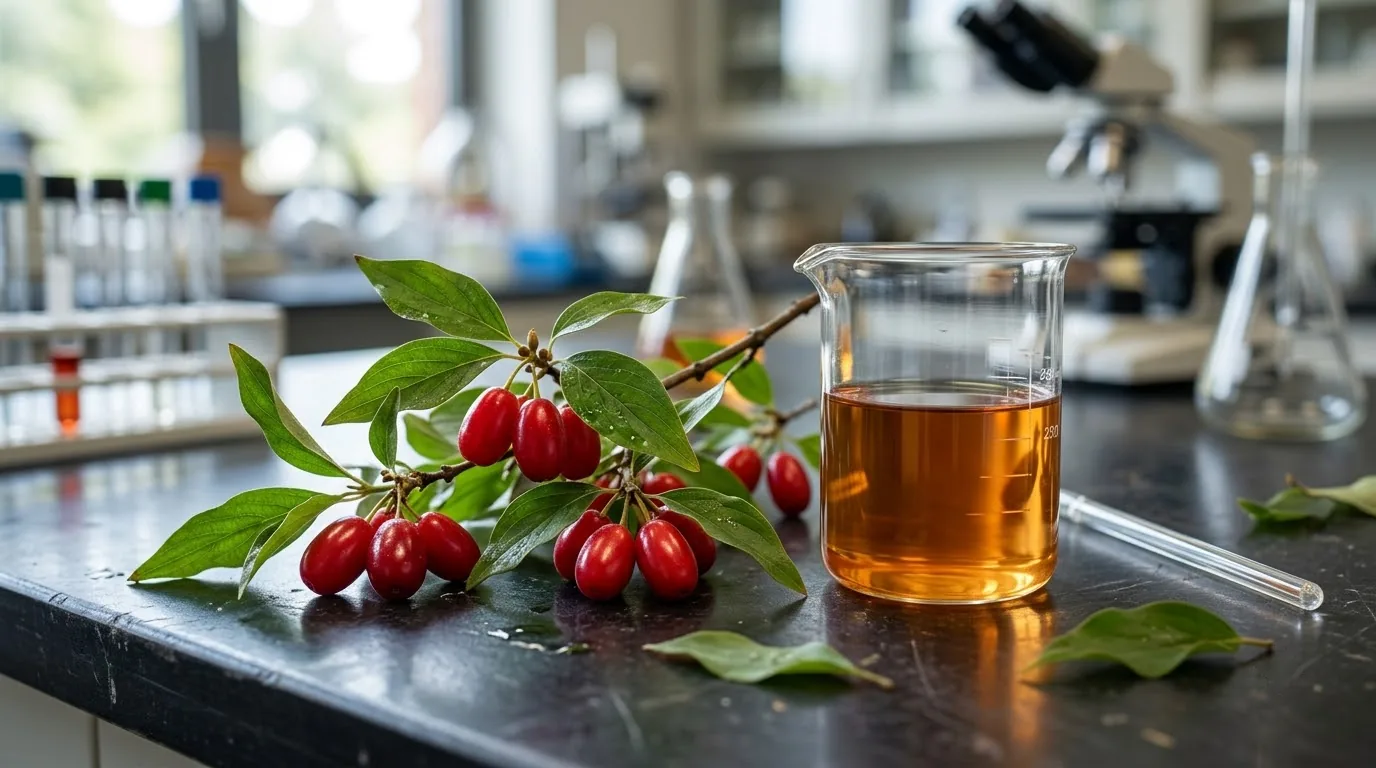
When an ingredient list says “Cornus extract,” every product can look like the same ingredient. But the chemical composition of an extract depends on which plant part was used, which solvent was used, and what it was mixed with. These are three variables to look at before the name when comparing ingredients.
1. Plant part: is only the flesh used?
In traditional Korean medicine, Cornus is the ripe red fruit with the seed removed and the flesh dried. The quality standard of the Korean Pharmacopoeia, a combined loganin and morroniside content of at least 1.2%, is also based on this flesh. Removing the seeds one by one is laborious, but it is the starting point for bringing the ingredient in line with the Pharmacopoeia standard.
2. Solvent and conditions: what is it steeped in?
Even with the same raw material, the compounds that dissolve out differ depending on whether water or ethanol is used for extraction. Temperature, time, and the methods of concentration and drying also change the result. For this reason, an individually approved ingredient has a fixed process, from the plant part through the solvent, temperature, and time, and marker compound specifications are used to confirm that each production batch has the same quality.
3. Blend ratio: what is it mixed with, and in what proportion?
Researchers at Ajou University School of Medicine and NINEB mixed Cornus and Ribes fasciculatum (Ribes fasciculatum) extracts at 9:1, 8:2, 7:3, and 6:4 and compared them in preadipocytes (Molecules). All four ratios lowered the expression of adipogenesis genes, but the suppression of FABP4 and PPARγ was greatest at 7:3, and the 7:3 blend was more effective than either extract alone. In a 12-week experiment in mice fed a high-fat diet, weight gain, visceral fat, and fatty liver were also reduced.
The Cornus extract complex made at this ratio later went through a 12-week human study in overweight women. In other words, even under the same name “Cornus,” a single extract and a 7:3 complex extract have built up their evidence along different paths.
When comparing ingredients
- Are marker compounds (such as loganin) managed by specification?
- Is the process (plant part, solvent, blend ratio) fixed?
- Has that exact ingredient been tested in humans?
The more important question is not the content of a single compound but whether the ingredient used in the study is the same as the ingredient you are looking at.
References
- Ministry of Food and Drug Safety (MFDS), Korean Pharmacopoeia, “Cornus fruit”
- Park E, et al.. Antiadipogenic Effects of Mixtures of Cornus officinalis and Ribes fasciculatum Extracts on 3T3-L1 Preadipocytes and High-Fat Diet-Induced Mice. Molecules. DOI: 10.3390/molecules25102350
- Park E, et al.. Efficacy and Safety of Combined Extracts of Cornus officinalis and Ribes fasciculatum for Body Fat Reduction in Overweight Women. Journal of Clinical Medicine. DOI: 10.3390/jcm9113629