The Chemistry of Loganin: How an Iridoid Became a “Marker Compound”
What kind of molecule is loganin, the signature compound of Cornus, and why is it used as a yardstick of quality? This article covers its biosynthetic pathway, the research landscape, and pitfalls in interpretation.
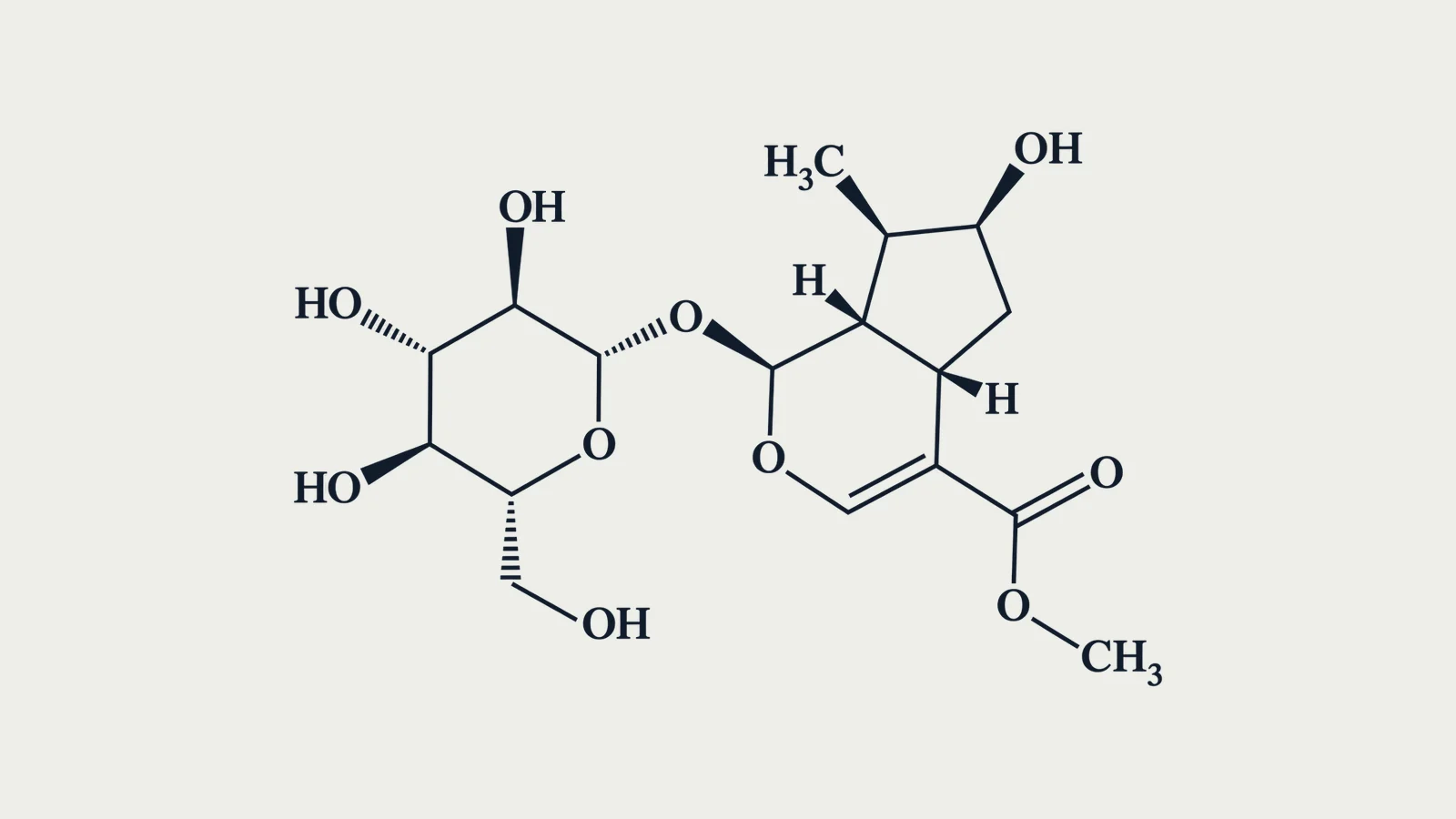
Loganin is a name that comes up whenever the fruit of Cornus (Cornus officinalis) is discussed. Yet where this molecule sits inside the plant and why it serves as a standard for quality control are rarely explained. This article covers the chemistry, the biosynthesis, and the course of the research, in that order.
The iridoid skeleton
Loganin is a compound of the iridoid class. Iridoids are derived from monoterpenes, which have 10 carbons, and share a cyclopenta[c]pyran skeleton in which a five-membered ring is fused to a six-membered ring containing oxygen. The name comes from the ant genus (Iridomyrmex) that secretes compounds of this class as defensive substances.
Loganin is a glycoside in which glucose is attached to this skeleton, and its carboxyl group is in the form of a methyl ester. It dissolves well in water and absorbs clearly in the ultraviolet range, so it is easy to quantify by high-performance liquid chromatography (HPLC). These properties connect to the conditions for a “marker compound,” described below.
Its place in the plant: a waypoint on the road to secologanin
In plants, loganin is closer to an intermediate stop than a final product. Biosynthesis starts from geraniol and, through oxidation and cyclisation, builds the iridoid skeleton; loganin is formed when loganic acid is methylated. Next, secologanin synthase, a cytochrome P450 enzyme, opens the five-membered ring to produce secologanin.
Secologanin combines with tryptamine to form strictosidine, which is the common precursor of more than 3,000 monoterpene indole alkaloids. The anticancer drugs vinblastine and camptothecin and the malaria drug quinine all come from this pathway. Loganin thus stands at a waypoint on one of the most productive pathways in plant chemistry.
Besides loganin, Cornus also contains iridoids and secoiridoids such as morroniside, sweroside, and cornuside.
Conditions for a “marker compound”
The Korean Pharmacopoeia sets a combined loganin and morroniside content of at least 1.2% as the quality standard for Cornus. A compound used to confirm the authenticity and quality of an ingredient in this way is called a marker compound. A good marker compound meets three conditions: it is characteristic of the ingredient, it can be quantified reliably, and it does not break down easily during processing and storage. Loganin tends to meet all three.
It is important that a marker compound and an active compound are not the same concept. A marker compound is a yardstick of quality that measures whether the same ingredient was made in each production batch. Fixing the marker compound content secures reproducibility, but it does not mean that this one compound explains all of the ingredient's action.
The research landscape
Research on loganin alone has also extended to metabolism. A joint research team from the Department of Medical Genetics at Ajou University School of Medicine and NINEB observed that in 3T3-L1 preadipocytes and adipose-derived stem cells, loganin lowered the expression of PPARγ, C/EBPα, FASN, PLIN2, and SREBP1 and reduced lipid droplet accumulation. In two mouse models, ovariectomised mice and mice fed a high-fat diet, weight gain and fatty liver were suppressed. The same group also reported that morroniside reduced intracellular triglycerides and increased glycerol release, and that 12 weeks of administration in mice suppressed weight gain.
These studies support, at the cell and animal level, the hypothesis that the iridoids of Cornus may be involved in the pathways of adipocyte differentiation. However, because they used a single purified compound, they should be read separately from the action of the whole ingredient.
A pitfall in interpretation: comparing compound doses
Body surface area conversion is used to translate compound doses from animal experiments into human intake, but it is a tool for estimating a starting dose for clinical trials, not a calculation that guarantees an effect. Moreover, an extract contains many other compounds besides the marker compound.
For this reason, the effect of an ingredient is judged by human studies of the ingredient as a whole, not by the content of a compound. In a 12-week randomised, double-blind study in overweight women (147 enrolled, 76 completed, with diet and exercise), a complex extract combining Cornus fruit and Ribes fasciculatum leaf at a 7:3 ratio reduced body fat percentage (0.76 percentage points vs. 0.01) and body fat mass (1.1 kg vs. 0.5 kg) significantly more than placebo in the group taking 1,600 mg a day. The reference in this study was 1,600 mg of the complex extract, not a certain number of milligrams of loganin. This is why a comparison along the lines of “the higher the loganin content, the better” does not hold.
Fibre Drunk as a Beverage Lowered Post-Meal Blood Glucose More: Meta-Analysis of 37 Trials
References
- Ministry of Food and Drug Safety (MFDS), Korean Pharmacopoeia, “Cornus fruit”
- Jeon H, et al.. Inhibitory Effects of Loganin on Adipogenesis In Vitro and In Vivo. International Journal of Molecular Sciences. DOI: 10.3390/ijms24054752
- Oh KI, et al.. Anti-adipogenic and anti-obesity effects of morroniside in vitro and in vivo. Biomedicine & Pharmacotherapy. DOI: 10.1016/j.biopha.2024.116762
- Park E, et al.. Efficacy and Safety of Combined Extracts of Cornus officinalis and Ribes fasciculatum for Body Fat Reduction in Overweight Women. Journal of Clinical Medicine. DOI: 10.3390/jcm9113629