4-Hydroxybenzoic Acid: From the Backbone of Parabens to Research on Fat Browning
Its structure is simple, but its uses are broad. This article looks at 4-HBA, a building block of coenzyme Q10, the parent compound of parabens, and a subject of browning research.
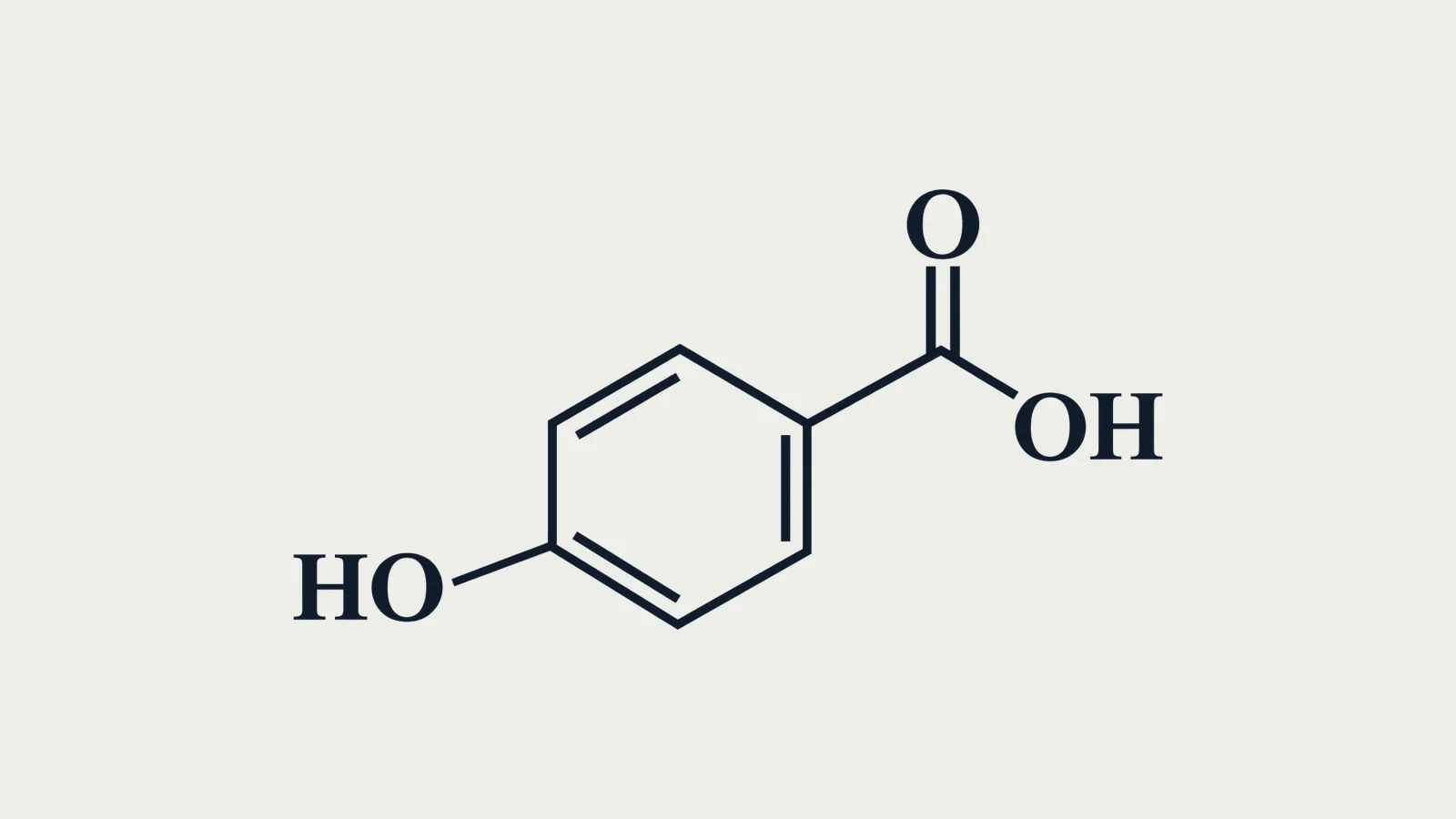
4-Hydroxybenzoic acid (4-HBA) is a simple molecule in which a carboxyl group and a hydroxyl group are attached to a benzene ring at opposite (para) positions. Thanks to this simplicity, it has several faces in both biology and industry.
The hydroxybenzoic acid family
4-HBA is a phenolic acid of the hydroxybenzoic acid class. Others in the same family include protocatechuic acid, vanillic acid, and gallic acid, which are widely distributed in fruits, vegetables, grains, and tea. In the leaves of Ribes fasciculatum (Ribes fasciculatum, called chilhaemok in Korean), a plant native to Korea, it is used as a marker compound for confirming the quality of the ingredient, and in black raspberry it has been reported as one of the main compounds.
Its use in the body: the ring of coenzyme Q10
4-HBA is also made in our own cells. Coenzyme Q10 (ubiquinone), which carries electrons in the mitochondrial electron transport chain, consists of a benzoquinone ring and a long isoprenoid tail, and the starting material for this ring is 4-HBA. Cells make 4-HBA from the amino acid tyrosine, and the COQ2 enzyme attaches the tail to it. In other words, this small phenolic acid sits at the heart of a key molecule of energy metabolism.
Its use in industry: the parent of parabens
Parabens, used as preservatives in cosmetics and food, are esters of 4-HBA. Methyl-, ethyl-, propyl-, and butylparaben are all forms in which an alcohol is attached to the carboxyl group of 4-HBA, and when absorbed by the body, the ester is hydrolysed and returns to 4-HBA. Because 4-HBA itself and its paraben esters differ in physical properties and behaviour in the body, they are not treated as the same substance.
Browning research: the AMPK–DRP1 axis
What drew attention to 4-HBA in metabolic research was fat browning. This is the phenomenon in which white adipocytes turn into heat-producing beige adipocytes, and the heat-generating protein UCP1 is central to it. Mitochondria repeatedly divide and fuse, and several studies have focused on the point that mitochondria with increased fission are favourable for heat production.
Researchers at the College of Korean Medicine at Kyung Hee University evaluated 4-HBA, a main compound of black raspberry, in 3T3-L1 white adipocytes, in male mice fed a high-fat diet, and in mice exposed to cold. 4-HBA increased browning markers such as UCP1, TBX1, and PRDM16 as well as oxidative phosphorylation complexes, and it changed mitochondrial dynamics factors such as phosphorylated DRP1 and mitofusin 1 (MFN1). The same changes were confirmed in the inguinal white fat of obese mice.
Causation was confirmed with blocking experiments. When Mdivi-1, a DRP1 inhibitor, blocked the mitochondrial fission induced by 4-HBA, the browning disappeared, and Compound C, an AMPK inhibitor, produced the same result. The pathway is summarised as “4-HBA → AMPK activation → DRP1-mediated fission → beiging.”
Seen through the whole plant
There is also a study that looked at the heat-generating effect of the Ribes fasciculatum extract itself. Researchers at the Korea Institute of Science and Technology (KIST) and elsewhere reported that when Ribes fasciculatum was fed to mice on a 45% high-fat diet, body temperature and UCP1 signals in white and brown adipose tissue rose and body weight fell, and they proposed the flavonoid afzelin as a candidate active compound. This shows that just because 4-HBA is a marker compound, the plant's action cannot be explained by 4-HBA alone.
What to look at when interpreting
Whether the concentrations used in cell experiments can be reached in the blood after intake, and whether it is the original molecule or a metabolite that acts, are questions that always remain in phenolic acid research. Browning mechanism studies are strong at showing “which pathways exist,” and the effect at actual intake levels should be judged separately by human studies.
Fibre Drunk as a Beverage Lowered Post-Meal Blood Glucose More: Meta-Analysis of 37 Trials
References
- Kim SH, et al.. 4-hydroxybenzoic acid induces browning of white adipose tissue through the AMPK-DRP1 pathway in HFD-induced obese mice. Phytomedicine. DOI: 10.1016/j.phymed.2024.156353
- Lee Y, et al.. Ribes fasciculatum Ameliorates High-Fat-Diet-Induced Obesity by Elevating Peripheral Thermogenic Signaling. Molecules. DOI: 10.3390/molecules27051649
- Park E, et al.. Antiadipogenic Effects of Mixtures of Cornus officinalis and Ribes fasciculatum Extracts on 3T3-L1 Preadipocytes and High-Fat Diet-Induced Mice. Molecules. DOI: 10.3390/molecules25102350