Natural Products & Plant Materials
Vaccine Adjuvant QS-21 Fully Biosynthesised in Yeast by Transferring 38 Enzymes From 6 Organisms
The saponin vaccine adjuvant QS-21, which depended on Chilean soapbark tree bark, was made from start to finish in genetically engineered yeast.

Researchers at the University of California, Berkeley, the Joint BioEnergy Institute and elsewhere in the United States succeeded in fully biosynthesising QS-21, a saponin-class vaccine adjuvant, in yeast. QS-21 is the only saponin-based adjuvant approved for use in humans, but its supply has been limited because it depends on extraction from the bark of the Chilean soapbark tree or on low-yield chemical synthesis.
Seven Enzyme Families, Balanced Expression of 38 Foreign Enzymes
The researchers put 38 foreign enzymes from 6 organisms into yeast and fine-tuned the host's own metabolic flow. Seven enzyme families were used in the pathway, including terpene synthases, cytochrome P450s, nucleotide sugar synthases, glycosyltransferases, CoA ligases, acyltransferases and polyketide synthases. They also mimicked in yeast the way reactions are divided between the endoplasmic reticulum membrane and the cytoplasm in plant cells. By taking advantage of the ability of some enzymes to accept multiple substrates, they also made structural analogs of QS-21.
This platform could be used to design stronger adjuvants through structure-activity relationship studies. However, according to the UC Berkeley announcement, production is only about 100 micrograms per litre of culture, so yield would need to improve before it could become an actual supply source.
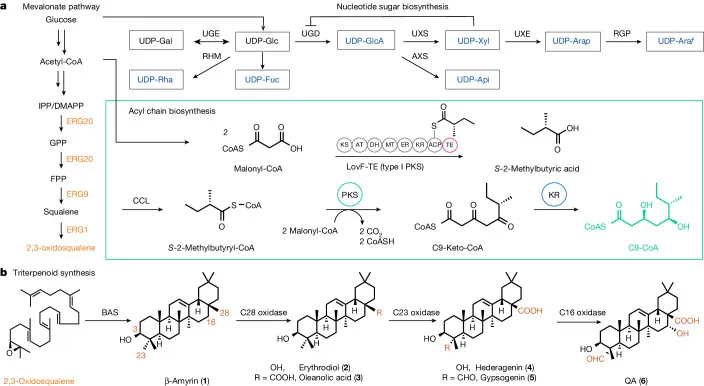
- 38 foreign enzymes from 6 organisms, 7 enzyme families, assembled in a single yeast strain
- Plant endoplasmic reticulum-cytoplasm reaction compartments reproduced in yeast
- Structural analogs of QS-21 also produced by exploiting enzyme substrate flexibility
Limitations Production is at the microgram-per-litre-of-culture level, so improving yield is a prerequisite for industrial supply.
Original research
- Liu Y, et al. · University of California, Berkeley. Complete biosynthesis of QS-21 in engineered yeast. Nature. DOI: 10.1038/s41586-024-07345-9
Copyright in the original research belongs to its publisher and authors.