Natural Products & Plant Materials
New Macrolide 'Canalesolide A' From Marine Cyanobacterium Kills Sleeping Sickness Parasites Within 1 Hour
UC San Diego researchers found a new macrolide in Okeania sp., solved its stereostructure and confirmed nanomolar activity against trypanosomes.
A joint team from the Scripps Institution of Oceanography at the University of California San Diego (UC San Diego) and its parasitic disease research centre discovered a new polyhydroxy macrolide, canalesolide A, in the marine cyanobacterium Okeania sp. It showed strong activity at low concentrations against Trypanosoma brucei, which causes African sleeping sickness. The paper was published in the Journal of the American Chemical Society.
Combining activity tracking with molecular networking
The team combined phenotypic screening against the parasite with LC-MS/MS-based molecular networking to quickly narrow down active fractions and filter out known compound families. To determine the structure, they used ultra-high-resolution NMR, empirical configuration analysis of the polyol, synthesis of model compounds, and chemical degradation and derivatisation. This resolved a stereochemistry that could not be solved by analysing the whole macrocycle at once. According to the team, the approach can be applied broadly to densely oxygenated marine macrolides. Genome analysis also suggested a putative biosynthetic gene cluster.
Canalesolide A showed activity in the low-nanomolar range against a human-infective T. brucei subspecies, and at 1 micromolar it killed the parasites within 1 hour. It is related to the known bastimolide family but differs distinctly in its structural arrangement.
Moderate toxicity to mammalian cells was observed, and in a preliminary experiment in infected mice the therapeutic window between efficacy and toxicity was narrow. The researchers themselves state that selectivity needs to be improved, and there is a long way to go before it could be applied in people.
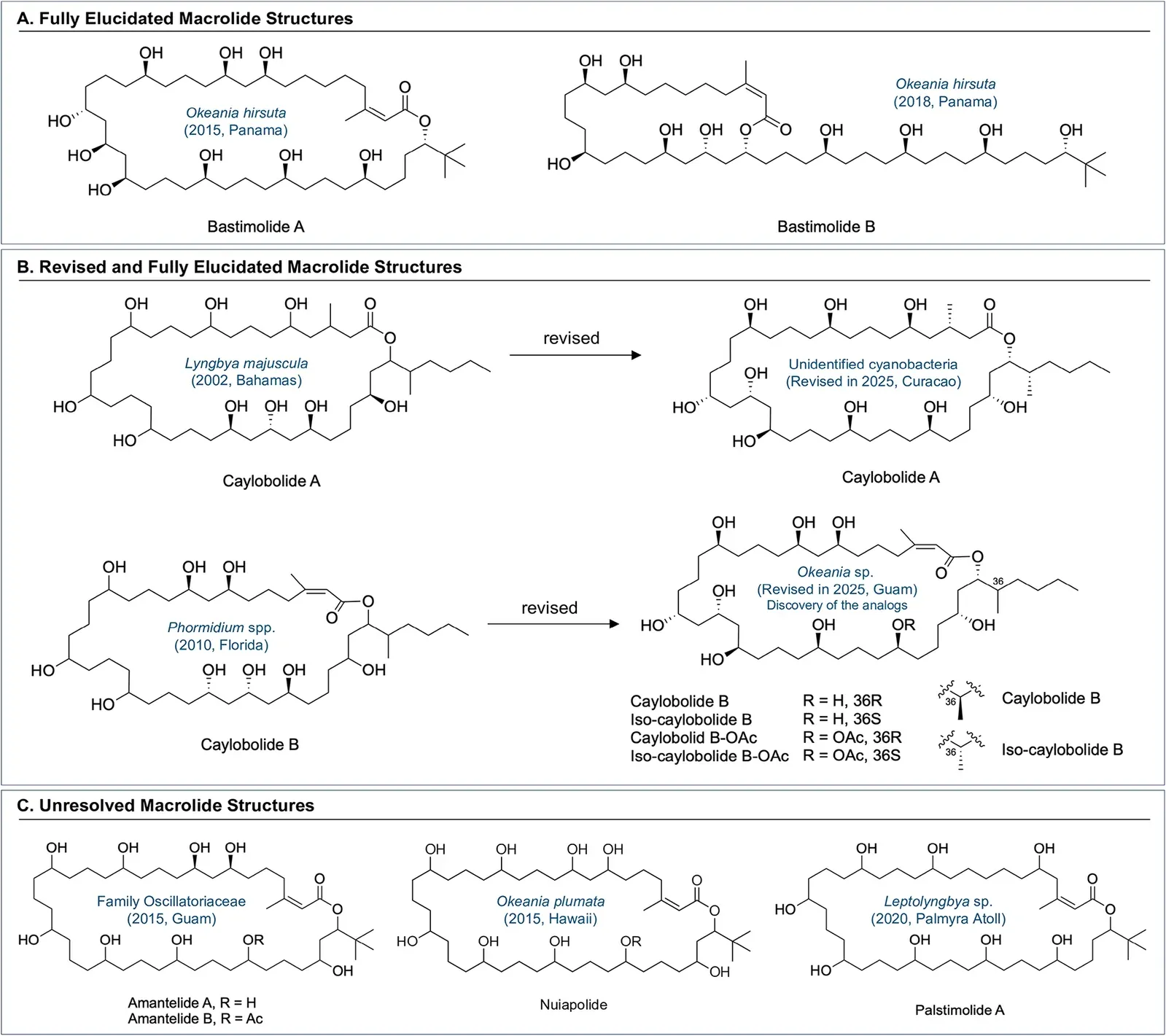
- New polyhydroxy macrolide found in the marine cyanobacterium Okeania sp., with its stereostructure fully determined by NMR, model synthesis and chemical degradation
- Low-nanomolar activity against human-infective T. brucei, killing the parasites within 1 hour at 1 µM
- Phenotypic screening plus molecular networking workflow and a putative biosynthetic gene cluster presented
Limitations Toxicity to mammalian cells was observed and the therapeutic window was narrow in a preliminary experiment in infected mice, so selectivity must be improved first.
Original research
- Teixeira TR, Ryu B, Cox R, Deering M, et al. · Scripps Institution of Oceanography / Skaggs School of Pharmacy, University of California San Diego. Canalesolide A, a Structurally Unique Polyhydroxy Macrolide from the Marine Cyanobacterium Okeania sp. with Potent Antitrypanosomal Activity. Journal of the American Chemical Society. DOI: 10.1021/jacs.6c11673
Copyright in the original research belongs to its publisher and authors.