Each 100 g More Ultraprocessed Food a Day Raises Cardiovascular Risk 14%: 51 Cohorts, 8.82 Million People
In a dose-response meta-analysis pooling data on 8,819,894 adults from 51 prospective cohort studies, ultraprocessed food intake was consistently associated with higher risk of cardiovascular disease, cancer, diabetes, depression and death. However, the certainty of the evidence is "low to moderate."

A large meta-analysis finding that the more ultraprocessed food (UPF) people eat, the higher their risk of major chronic diseases has been published in Family Medicine and Community Health, a BMJ Group journal. Researchers at Duke-NUS Medical School in Singapore and Sun Yat-sen University in China pooled and analysed data from 51 previously published prospective cohort studies of 8,819,894 adults. Follow-up ranged from 2 to 32 years, and the mean age of participants varied from 23 to 77.
Compared with those who ate the least, the group with the highest intake had hazard ratios (HR) of 1.24 for cardiovascular events, 1.12 for cancer, 1.23 for overweight and obesity, 1.24 for metabolic syndrome and diabetes, 1.27 for depression and anxiety, 1.31 for digestive disease and 1.18 for all-cause death. In the dose-response analysis, each 100 g increase in daily intake tended to raise the risk of cardiovascular events by 14% (HR 1.14, 95% confidence interval 1.06 to 1.22), cancer by 4%, all-cause death by 3% and metabolic syndrome and diabetes by 2%.
Significance and limits
Noting that diseases related to ultraprocessed food often overlap in the same person, the researchers interpreted reducing intake and switching to minimally processed foods as possibly meaningful for preventing chronic disease in primary care. On the other hand, all included studies relied on self-reports such as food frequency questionnaires, and UPF intake is entangled with lifestyle factors such as income, smoking and exercise, so residual confounding cannot be fully ruled out. The authors themselves rated the certainty of the evidence as mostly "low" or "moderate." Because this is a synthesis of observational studies, it does not prove causation.
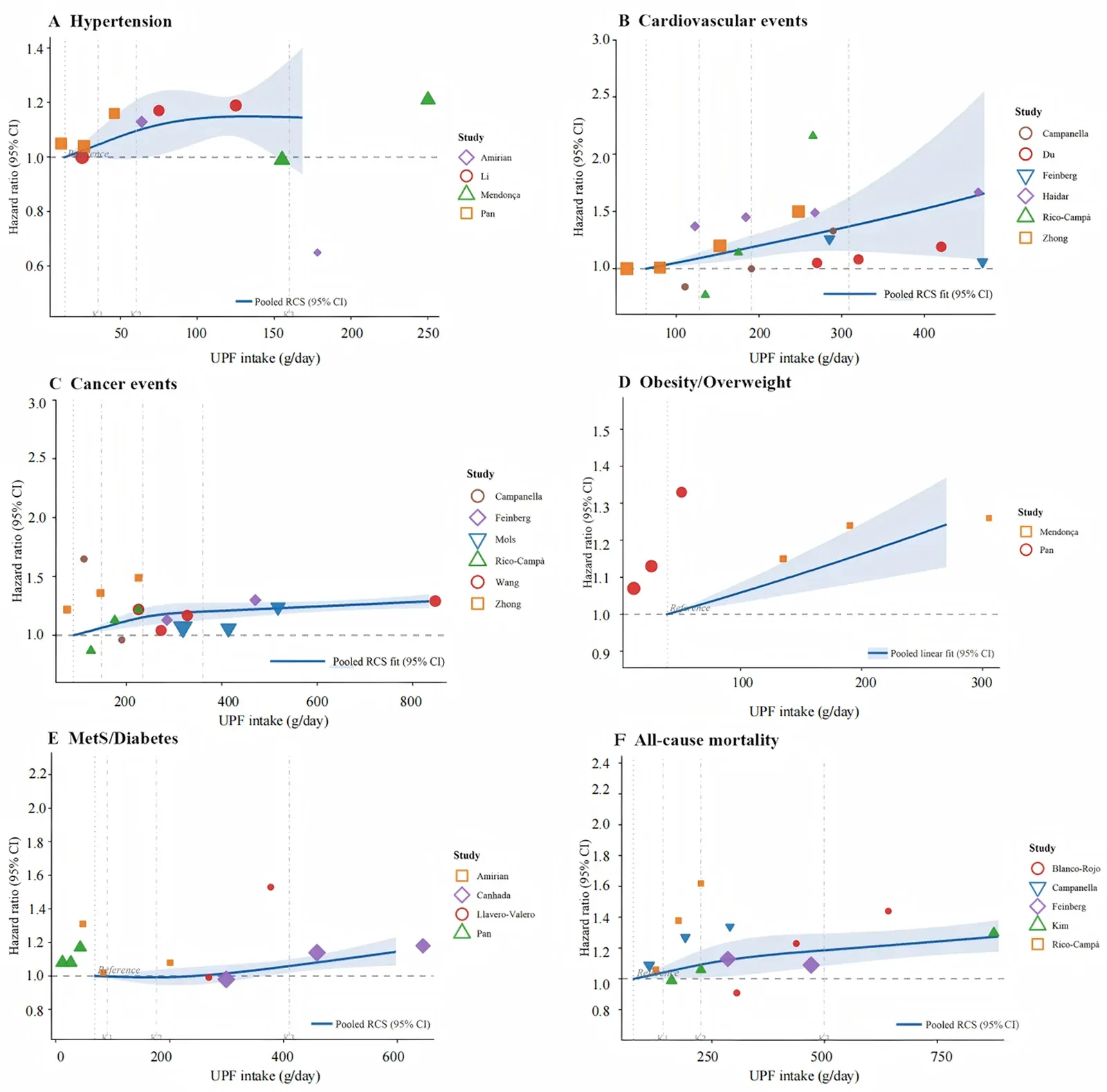
- Pooled analysis of 51 cohorts, 8,819,894 people, follow-up of 2 to 32 years
- Per 100 g/day increase: cardiovascular events HR 1.14, cancer 1.04, death 1.03
- Certainty of evidence generally low to moderate, relying on self-reported dietary data
Limitations A meta-analysis of observational studies that does not prove causation. Dietary assessment was self-reported and lifestyle confounders were not fully controlled.
Original research
- Liu X, Luo S, Zeng Y, et al. · Duke-NUS Medical School (Singapore) and Sun Yat-sen University (China). Ultra-processed food consumption and risk of multiple chronic diseases among 8,819,894 adults from 51 prospective cohorts: a dose-response meta-analysis. Family Medicine and Community Health. DOI: 10.1136/fmch-2026-003925
Copyright in the original research belongs to its publisher and authors.