Microplastics in Postmortem Brain Tissue Up About 50% in 8 Years, 7 to 30 Times Higher Than in Liver and Kidney
Autopsy samples showed higher plastic concentrations in the brain than in the liver or kidney, but the authors said they do not show a causal health effect.
A study published in Nature Medicine found far more micro- and nanoplastics in the brain tissue of deceased people than in the liver or kidney. The team of Matthew Campen at the University of New Mexico in the United States confirmed the presence of plastics in forensic autopsy samples by combining Py-GC-MS, attenuated total reflectance infrared spectroscopy (ATR-FTIR) and electron microscopy with energy-dispersive spectroscopy.
They compared the frontal cortex, liver and kidney of people who died in two periods eight years apart (20 to 28 people per period). The median plastic level in brain samples from the later period was 4,917 μg per gram, about 50% higher than in the earlier period (3,345 μg), and 7 to 30 times higher than in the liver (433 μg) and kidney (404 μg) from the same period. About 75% of the polymers in the brain were polyethylene, mostly in the form of sharp, nano-sized fragments. In the brains of 12 people with a history of a dementia diagnosis, the median was higher still, at 26,076 μg/g.
Uncertainty in the numbers and interpretation
The authors said these results are an association and do not show that plastics cause health effects. The high concentrations in the brains of people with dementia could be a result of brain atrophy or damage to the blood-brain barrier. Py-GC-MS is not standardised for tissue analysis, and measurement variability within the same sample was about 25%. Criticism of the method has also been raised that biological components such as lipids can inflate the polyethylene signal. There is also the difference that earlier-period samples had been stored for much longer. Follow-up studies are needed to clarify exposure routes and how plastics accumulate in and are cleared from the body.
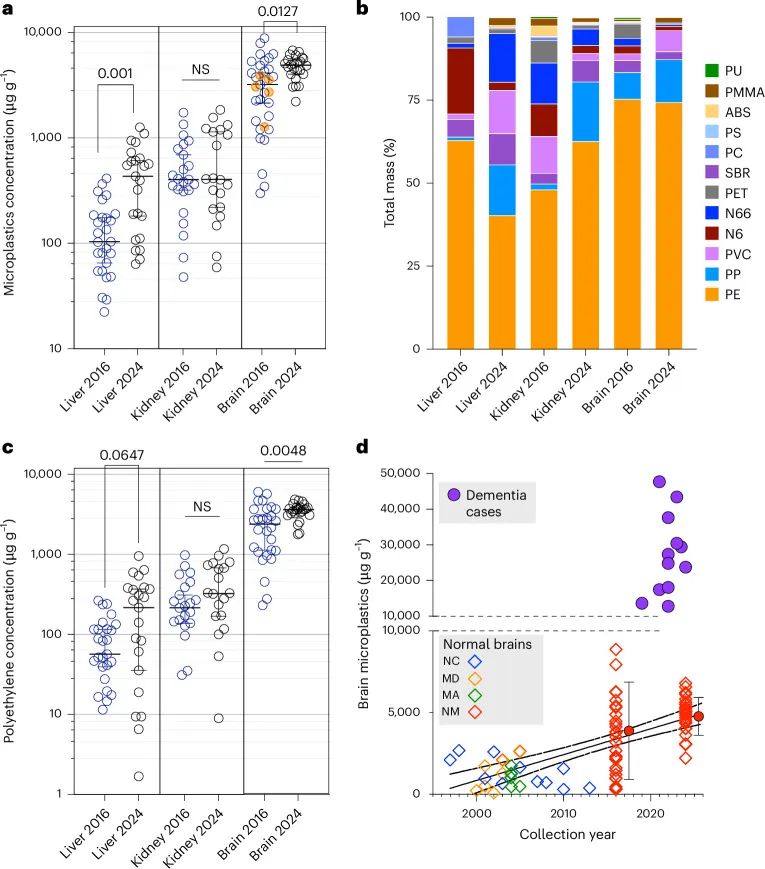
- Median plastic level in the brain (frontal cortex) 4,917 μg/g, up about 50% from samples 8 years earlier
- 7 to 30 times higher than in liver and kidney; about 75% of polymers were polyethylene
- Median in the brains of 12 people with dementia was 26,076 μg/g; the authors state it is not causal
Limitations This is an analysis of association in autopsy samples, and uncertainty in Py-GC-MS quantification and differences in sample storage time may affect the results.
Original research
- Nihart AJ, et al. · University of New Mexico Health Sciences. Bioaccumulation of microplastics in decedent human brains. Nature Medicine. DOI: 10.1038/s41591-024-03453-1
Copyright in the original research belongs to its publisher and authors.