Multivitamins Fail to Lower Risk of Death Even After Up to 27 Years of Follow-Up in 390,000 People
In an analysis of 390,000 U.S. adults without chronic disease, no association was seen between taking multivitamins and a lower risk of death.

One in three U.S. adults takes a multivitamin hoping to prevent disease, but once again evidence that it helps them live longer was not found. Researchers at the U.S. National Cancer Institute (NCI) analysed data on 390,124 adults from three prospective cohorts: the NIH-AARP Diet and Health Study, the PLCO Cancer Screening Trial, and the Agricultural Health Study.
Adjusting for the Healthy-User Effect
The participants had no history of cancer or other chronic disease, and during follow-up of up to 27 years, 164,762 of them died. People who took a daily multivitamin were more likely to be women and college graduates and less likely to be smokers, so they tended to have better health habits to begin with. To reduce this lifestyle confounding, and reverse causation, in which people start taking vitamins after their health worsens, the researchers split the follow-up period into first and second halves for analysis.
As a result, the hazard ratio for all-cause death among daily users was 1.04 in the first half and 1.04 in the second half, showing no association with lower mortality, and it was in fact 4% higher in the first half. Results were similar by major cause of death, such as cancer and cardiovascular disease, and in analyses that accounted for changes in use over time.
Use was self-reported, and product ingredients and doses could not be distinguished. Because this is an observational study, causation cannot be established, and it does not answer whether supplementation is needed for people with a specific deficiency.
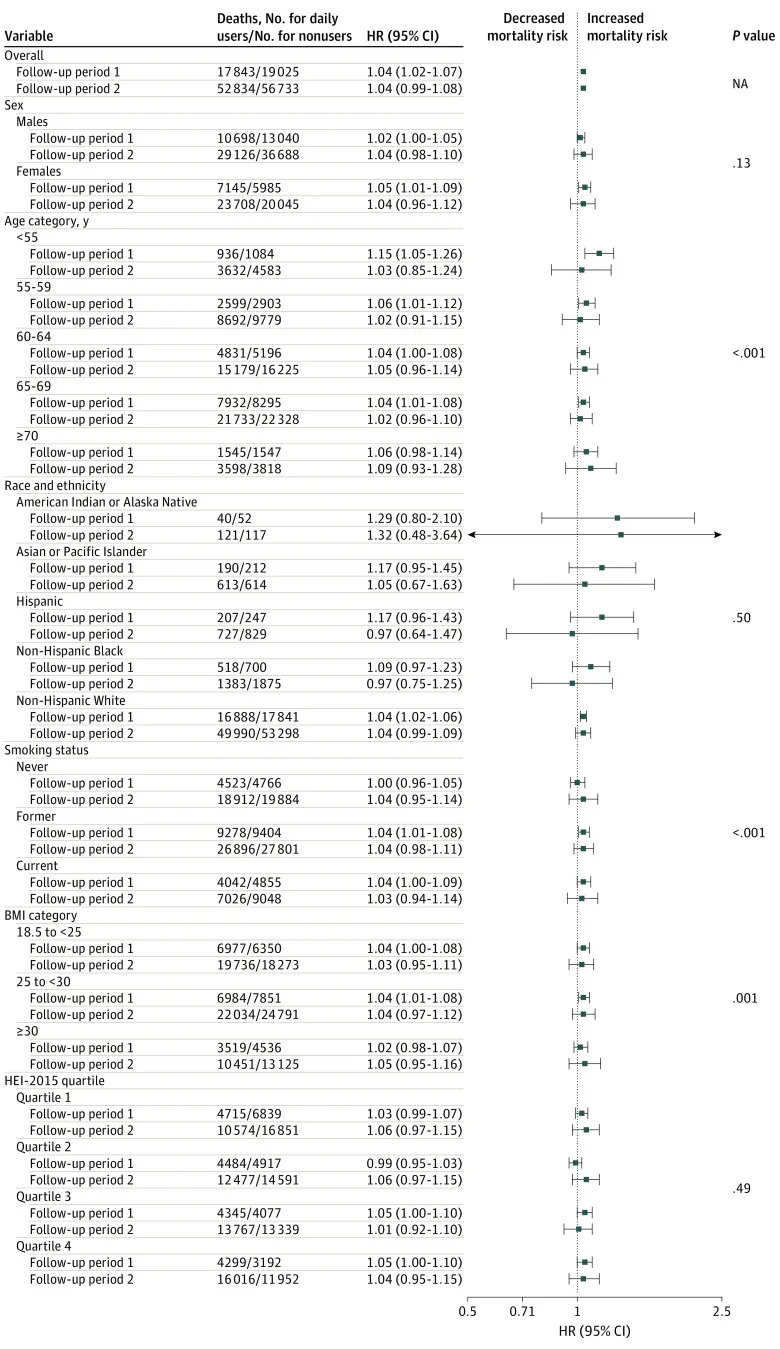
- 390,124 people in 3 cohorts, up to 27 years of follow-up, 164,762 deaths
- Hazard ratio for all-cause death among daily users 1.04 (first half) and 1.04 (second half): no benefit
- Similar results by major cause of death and in time-varying analyses
Limitations This is a self-report-based observational study that cannot establish causation, and supplementation to correct a deficiency is a separate question.
Original research
- Loftfield E, et al. · National Cancer Institute, NIH. Multivitamin Use and Mortality Risk in 3 Prospective US Cohorts. JAMA Network Open. DOI: 10.1001/jamanetworkopen.2024.18729
Copyright in the original research belongs to its publisher and authors.