Intermittent Fasting Works About as Well as Standard Calorie Restriction: Network Meta-Analysis of 99 Trials
Intermittent fasting, such as time-restricted eating and alternate-day fasting, showed no large difference from daily calorie reduction in improving weight and metabolic markers.

An analysis found that the evidence that intermittent fasting is better than eating a little less every day is still lacking. An international team of researchers, including Harvard T.H. Chan School of Public Health, pooled data from 99 randomised controlled trials covering 6,582 adults and performed a network meta-analysis. The strategies compared were alternate day fasting, time restricted eating, whole day fasting, continuous calorie restriction and eating without restriction.
Only alternate-day fasting had a slight edge
All intermittent fasting strategies and continuous calorie restriction reduced weight more than eating without restriction. Compared with continuous calorie restriction, only alternate-day fasting showed a meaningful difference, with an average of 1.29 kg more weight loss (moderate certainty of evidence). Alternate-day fasting produced 1.69 kg more weight loss than time-restricted eating and also lowered total cholesterol and triglycerides more. By contrast, there was no difference between eating strategies in HbA1c or HDL cholesterol.
Notably, when only the 17 trials lasting 24 weeks or longer were examined, the differences between fasting methods disappeared, and only the effect compared with eating without restriction remained. The researchers concluded that intermittent fasting offers benefits similar to continuous calorie restriction, adding that longer trials are needed. A limitation is that most of the included trials were short and the participants' health status varied.
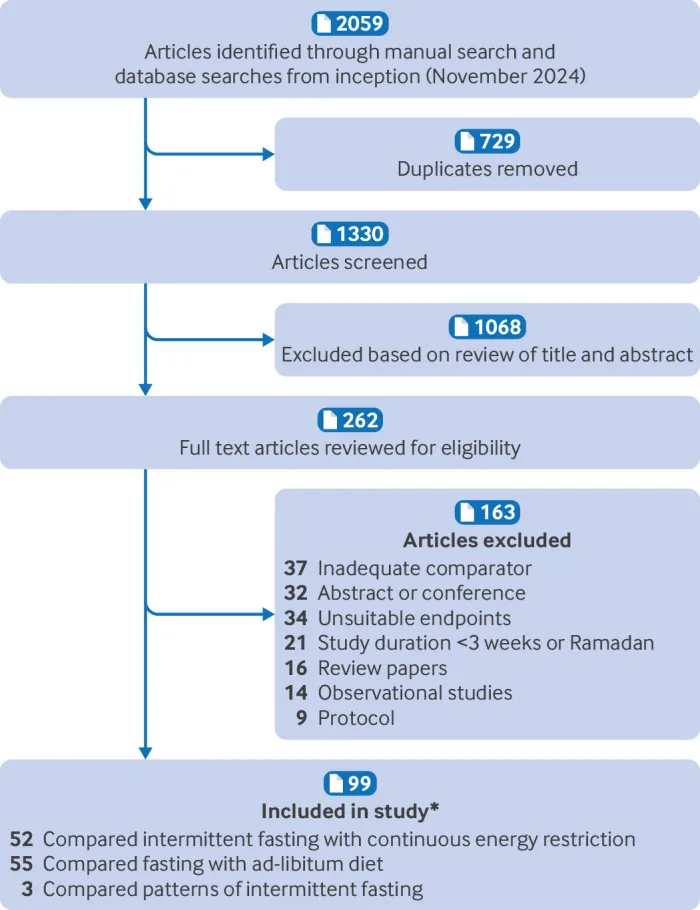
- Network meta-analysis of 99 randomised trials and 6,582 adults
- Only alternate-day fasting led to 1.29 kg more weight loss than continuous calorie restriction
- In longer trials of 24 weeks or more, differences between methods disappeared; no difference in HbA1c
Limitations Many of the included trials were short and the participants were heterogeneous, so the evidence is insufficient for comparing long-term effects.
Original research
- Semnani-Azad Z, et al. · Harvard T.H. Chan School of Public Health. Intermittent fasting strategies and their effects on body weight and other cardiometabolic risk factors: systematic review and network meta-analysis of randomised clinical trials. BMJ. DOI: 10.1136/bmj-2024-082007
Copyright in the original research belongs to its publisher and authors.