5,000 to 7,500 Steps a Day Slow Tau Buildup and Cognitive Decline in Older Adults With Amyloid
In cognitively normal older adults with high amyloid levels, more steps were associated with slower tau accumulation and slower cognitive decline, an observational finding.

Physical inactivity is a leading modifiable risk factor for Alzheimer's disease, but how it is actually linked to the progression of brain pathology has been unclear. Researchers at Mass General Brigham in the United States published in Nature Medicine the results of a long-term follow-up of step counts together with brain imaging.
296 cognitively normal older adults, followed for an average of 9.3 years
The researchers had 296 cognitively normal people aged 50 to 90 in the Harvard Aging Brain Study wear a hip pedometer to measure step counts. They then gave cognitive tests every year for 2 to 14 years (average 9.3 years), and some had repeated tau PET scans.
Among people with high amyloid at the start, more steps were associated with slower decline in cognitive and daily function. This relationship was independent of the amount of amyloid and instead was associated with slower tau accumulation in the inferior temporal lobe, and tau mediated a substantial part of the link with cognitive decline. The effect peaked at about 5,001 to 7,500 steps a day. According to the press release, 3,000 to 5,000 steps was associated with a delay in cognitive decline of about 3 years, and 5,000 to 7,500 steps with about 7 years. People with low amyloid had almost no decline at all.
Limitations
As an observational study, it does not prove that walking causes slower progression of pathology. Step counts were measured only once, for one week, exercise intensity could not be distinguished, and participants were mostly highly educated white people, which limits generalisation.
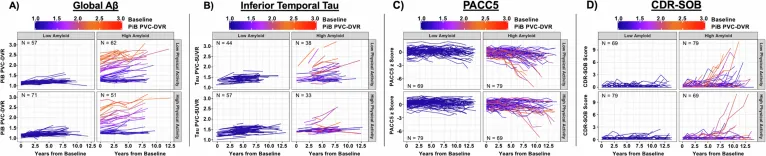
- 296 cognitively normal older adults, with pedometer step counts and up to 14 years of cognitive and tau PET follow-up
- In people with high amyloid, more steps meant slower tau accumulation and cognitive decline, independent of amyloid amount
- The association peaks at 5,001 to 7,500 steps a day (curved dose-response)
Limitations This is an observational study, not proof of causation. Step counts were measured for only one week at one time point, and the sample is mostly highly educated white people.
Original research
- Yau WW, et al. · Mass General Brigham. Physical activity as a modifiable risk factor in preclinical Alzheimer's disease. Nature Medicine. DOI: 10.1038/s41591-025-03955-6
Copyright in the original research belongs to its publisher and authors.