838 People, 47 Tissues: Mitochondrial Mutations Act as Two Kinds of Ageing Clock
In tissues with frequent cell turnover, random mutations built up with age, while in the heart and brain, mutations at specific positions did.

An analysis published in Nature Aging shows that mutations accumulating in the mitochondrial genome work as different kinds of molecular clock depending on the tissue type. The results come from researchers at the Shanghai Institute of Nutrition and Health, Chinese Academy of Sciences.
Mitochondrial RNA analysis of 838 GTEx donors
The researchers used RNA data from 47 tissues of 838 donors aged 20 to 70 in the US Genotype-Tissue Expression (GTEx) project to find mitochondrial somatic variants. They found that clonal mosaicism, in which a variant arising in some cells spreads, increased rapidly with age, and that the pattern fell into two broad types.
In tissues where cells are constantly replaced, such as the gastrointestinal tract and skin, random replication errors accumulated and clonal expansion accelerated. The researchers suggested this may be related to vulnerability to ageing-related tumours and functional decline. By contrast, in tissues that rarely divide, such as the heart and brain, variants accumulated repeatedly at tissue-specific hotspot positions. This was interpreted as reflecting the cumulative burden left by high energy demand and mitochondrial turnover.
The study is significant in presenting a map of tissue-specific vulnerability to ageing, but it is a cross-sectional analysis of postmortem donor tissue at a single time point, so it did not track changes within an individual over time. Whether these variants cause ageing requires separate validation.
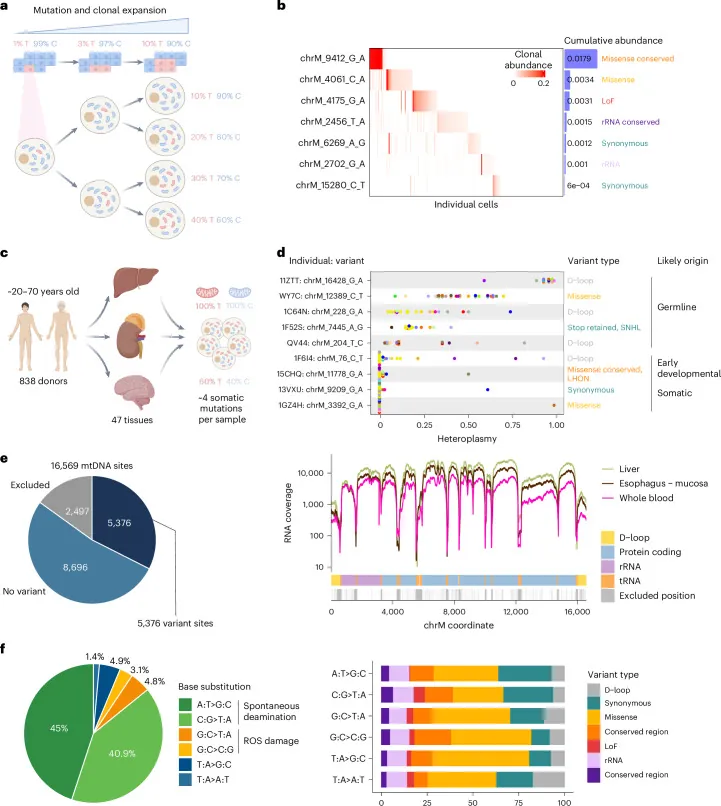
- Mitochondrial somatic variants analysed in RNA from 47 tissues of 838 GTEx donors (aged 20 to 70)
- In dividing tissues such as the gastrointestinal tract and skin, random mutation accumulation and clonal expansion accelerated
- In non-dividing tissues such as the heart and brain, mutations repeatedly accumulated at tissue-specific hotspots, a dual structure
Limitations This is a cross-sectional analysis of postmortem donor tissue, so changes over time within individuals and causal relationships have not been confirmed.
Original research
- Wang Z, et al. · Shanghai Institute of Nutrition and Health, Chinese Academy of Sciences. Mitochondrial clonal mosaicism encodes a biphasic molecular clock of aging. Nature Aging. DOI: 10.1038/s43587-025-00890-6
Copyright in the original research belongs to its publisher and authors.