The Science of Resistant Maltodextrin: Dextrinization, Bond Structure, and 37 Trials
How does starch become a dietary fiber that is not digested? This article covers the manufacturing chemistry, metabolism, and the strength and limits of the evidence on post-meal blood glucose.
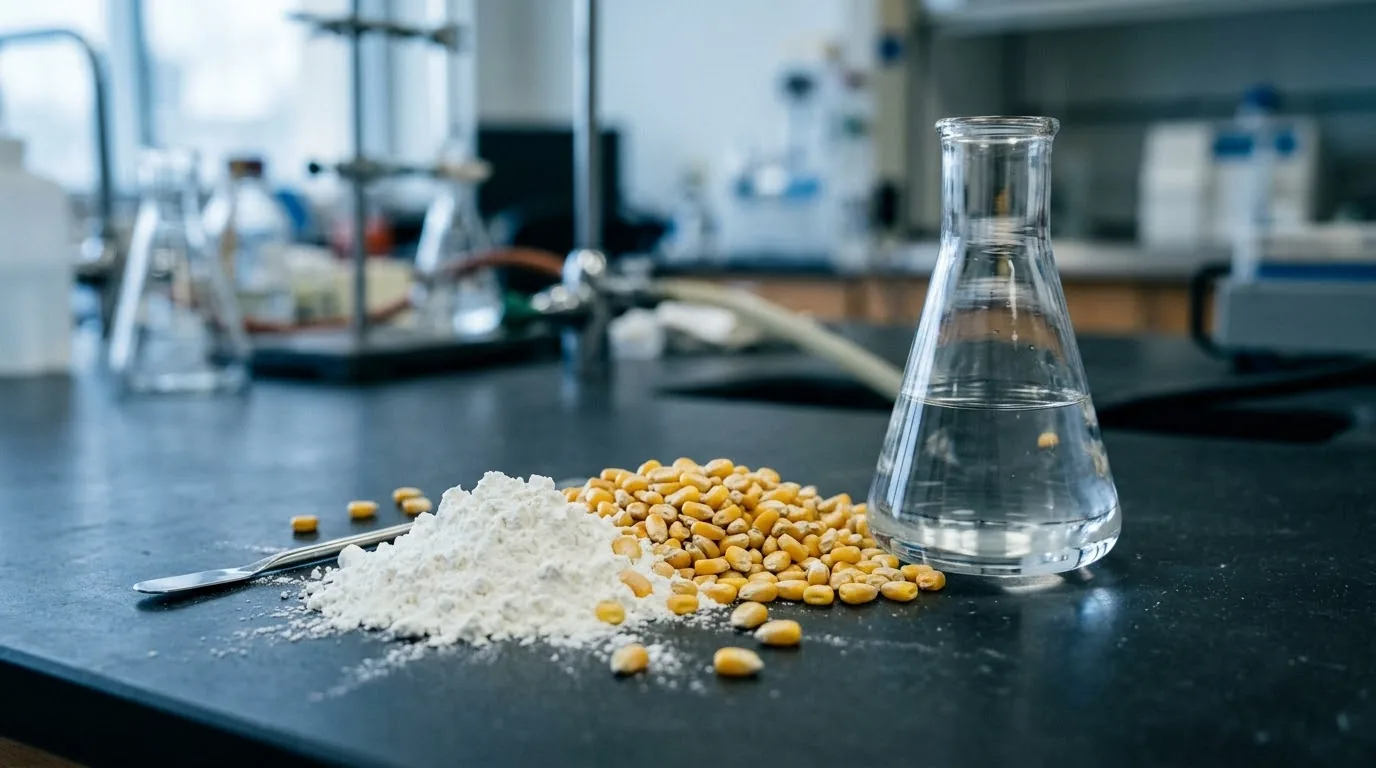
Resistant maltodextrin is a soluble dietary fiber made from starch. The key point of this ingredient is that the raw material is a carbohydrate but the product is a dietary fiber. That difference comes from the way the glucose units are linked, that is, the bond structure.
How starch becomes fiber
Starch is a structure in which glucose is linked in long chains by α-1,4 bonds and branched by α-1,6 bonds. Human amylase and small-intestine enzymes cleave both of these bonds readily. Resistant maltodextrin starts from pyrodextrinization, in which mainly corn starch is heated to a high temperature with a small amount of acid added. In this process, bonds are broken and re-formed, producing atypical bonds such as α-1,2 and α-1,3 bonds and complex branching.
Enzymes then break down the digestible portion, and decolorization, ion exchange, and chromatographic separation collect the fraction that is not digested. The result is a low-molecular-weight dietary fiber that dissolves well in water and has almost no viscosity or taste. Because of its small molecular size, it was not captured by earlier methods for measuring dietary fiber, but once an official analytical method (AOAC 2001.03) that includes it was established, it could be quantified as dietary fiber.
Its fate in the body
According to a study that modeled measurements of breath gas and exhaled hydrogen in 17 healthy adults, only about 17% of resistant maltodextrin was used as digested and absorbed carbohydrate, and about 40% was fermented in the large intestine. Its metabolizable energy was about 7.3 kJ per gram (about 1.7 kcal), less than half the 4 kcal per gram of ordinary carbohydrate. The fermented portion feeds gut bacteria and leads to the production of short-chain fatty acids.
Evidence on post-meal blood glucose: a meta-analysis of 37 trials
The most widely cited evidence is a meta-analysis published in The American Journal of Clinical Nutrition. It pooled 37 randomized, placebo-controlled trials in which healthy adults were given 10 g or less, and the test meals were rice, noodles, pastries, bread, and refined carbohydrate, with available carbohydrate ranging from 30 to 173 g.
Three results stand out. First, the reduction in the blood glucose response was dose-dependent. Second, it was unrelated to the amount of carbohydrate eaten with it. Third, the difference was large depending on how it was consumed. At 6 g, drinking it as a beverage reduced the blood glucose response to starchy foods by about 20%, but mixing it into food reduced it by about 10%. Funnel plots and adjusted analyses showed no systematic bias, and the heterogeneity seen in the group of studies with non-profit authors was attributed to some trials with lower precision.
The mechanism has not been settled. Delayed sugar absorption in the small intestine and changes in gastric emptying and intestinal transit time have been suggested, but how a fiber with almost no viscosity changes the rate of absorption is still an area of ongoing research.
Compared with other low-digestible carbohydrates
In an exploratory study in which Korean researchers compared allulose, 1-kestose, resistant maltodextrin, and fructooligosaccharide under the same conditions, the response differed by ingredient. Allulose lowered post-meal blood glucose and insulin the most, and resistant maltodextrin significantly increased subjective fullness from 30 to 180 minutes after intake. This means that low-digestible carbohydrates should not be lumped together, and the measures for which evidence has accumulated should be looked at separately for each ingredient. It should also be kept in mind that this was a small exploratory study supported by an ingredient manufacturer.
Regulatory status
Resistant maltodextrin was developed in Japan and has been widely used as an ingredient in Foods for Specified Health Uses (FOSHU). In Korea, it is a health functional food ingredient whose standards and specifications are notified by the MFDS, and three functions are recognized: it may help suppress the rise in blood glucose after meals, may help improve blood triglyceride levels, and may help support regular bowel movements. A separate daily intake standard is set for each function.
Summary
The evidence on resistant maltodextrin and post-meal blood glucose is fairly solid in that many randomized controlled trials in humans have accumulated. At the same time, the most practical message of the meta-analysis is that the size of the effect varies with how it is consumed and the dose. Taking a high dose at one time may cause gastrointestinal symptoms such as abdominal bloating or loose stools.
Fiber Drunk as a Beverage Lowered Post-Meal Blood Glucose More: Meta-Analysis of 37 Trials
References
- Livesey G, Tagami H. Interventions to lower the glycemic response to carbohydrate foods with a low-viscosity fiber (resistant maltodextrin): meta-analysis of randomized controlled trials. The American Journal of Clinical Nutrition. DOI: 10.3945/ajcn.2008.26842
- Goda T, et al.. Availability, fermentability, and energy value of resistant maltodextrin: modeling of short-term indirect calorimetric measurements in healthy adults. The American Journal of Clinical Nutrition. DOI: 10.1093/ajcn/83.6.1321
- Noh J, et al.. Differential Modulation of Postprandial Glycemic, Incretin, and Satiety Responses by Low-Digestible Carbohydrates in Humans: An Exploratory Investigation. Nutrients. DOI: 10.3390/nu18111742
- Ministry of Food and Drug Safety (MFDS), Standards and Specifications for Health Functional Foods, “Resistant maltodextrin”