Blood p-tau217 Test Matches Cerebrospinal Fluid Test in Accuracy for Identifying Alzheimer's Pathology
A plasma p-tau217 ratio test found Alzheimer's pathology as accurately as an FDA-cleared cerebrospinal fluid test and was better at identifying tau.

A blood test that identifies amyloid-β plaques and tau tangles, the core pathology of Alzheimer's disease, showed accuracy on par with the existing cerebrospinal fluid (CSF) test. The result was published in Nature Medicine by a joint research team from Washington University School of Medicine in the United States and Lund University in Sweden.
1,759 People in Two Cohorts, Compared Against PET Imaging
The researchers used mass spectrometry to measure the ratio of phosphorylated tau217 to nonphosphorylated tau (%p-tau217) in plasma from 1,422 people in the Swedish BioFINDER-2 cohort and 337 people in the U.S. Knight ADRC cohort. Cerebrospinal fluid from the same people was measured with an FDA-cleared automated immunoassay used in clinical practice, and the presence of actual brain pathology was determined using positron emission tomography (PET) as the reference. For identifying amyloid PET status, the area under the curve (AUC) of both tests was 0.95 to 0.97, and for tau PET status the blood test was generally better, at 0.95 to 0.98.
Looking only at patients with mild cognitive impairment or mild dementia, who are the target for antibody treatments, accuracy, positive predictive value and negative predictive value were 89% to 90% for amyloid and 87% to 88% for tau. Using two cutoffs and sending only the intermediate zone for additional testing raised this to 95%.
Significance and Limits
Because it widens the ways to confirm pathology without a lumbar puncture or expensive PET, it could improve access to diagnosis. However, the participants came mainly from specialized research cohorts, and mass spectrometry-based testing is hard to roll out immediately at general medical institutions. Further validation is needed across diverse racial groups and in primary care settings.
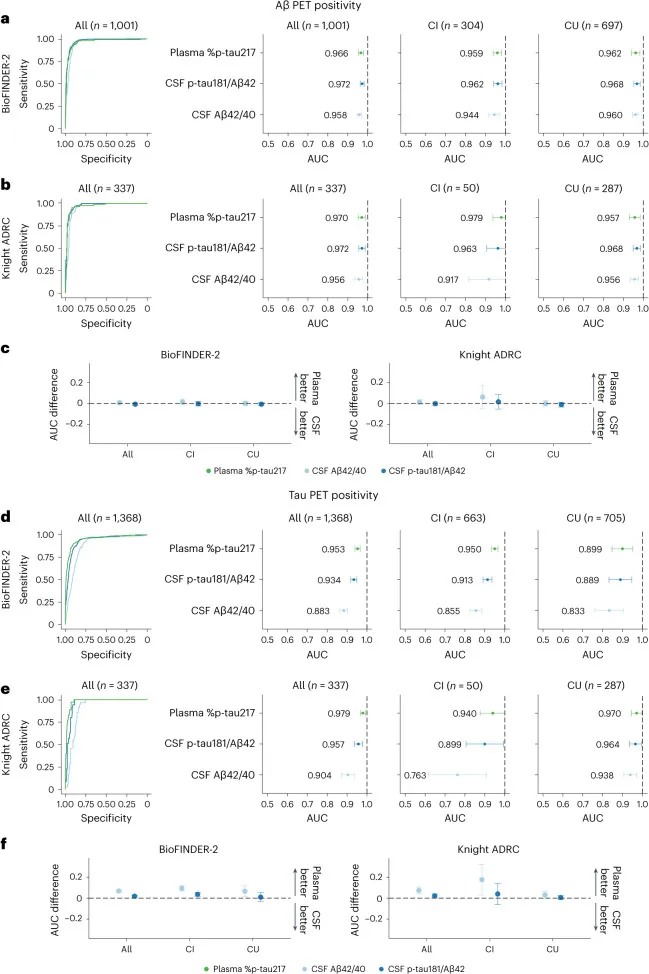
- 1,759 people in two cohorts in Sweden and the U.S., blood and cerebrospinal fluid tests compared against PET
- AUC for identifying amyloid was on par at 0.95-0.97, and for tau the blood test was better at 0.95-0.98
- Accuracy of 87-90% in patients with cognitive impairment, and 95% with dual cutoffs
Limitations This diagnostic accuracy study was centered on research cohorts, and performance in general clinical practice and in diverse populations needs separate validation.
Original Research
- Barthélemy NR, Salvadó G, et al. · Washington University School of Medicine / Lund University. Highly accurate blood test for Alzheimer's disease is similar or superior to clinical cerebrospinal fluid tests. Nature Medicine. DOI: 10.1038/s41591-024-02869-z
Copyright in the original research belongs to its publisher and authors.