6 Weeks of Ketogenic Diet for Treatment-Resistant Depression Lowers Depression Scores Slightly More Than a Control Diet
In a randomized trial in the U.K., the ketogenic diet lowered depression scores slightly more than a healthy control diet, but the clinical meaning was uncertain.

Animal studies and case reports have suggested that the ketogenic diet, which cuts carbohydrates to an extreme, may help with depression, but well-controlled clinical evidence has been lacking. Researchers at the Nuffield Department of Primary Care Health Sciences at the University of Oxford in the U.K. published in JAMA Psychiatry the results of a randomized controlled trial (RCT) in patients with treatment-resistant depression.
88 people, a 6-week diet comparison
Eighty-eight patients with treatment-resistant depression aged 18 to 65 were split into two groups. One group followed a prepared ketogenic diet with less than 30 g of carbohydrate a day for 6 weeks, and the other followed a control diet (phyto diet) that increased vegetables and fruit and replaced saturated fat with unsaturated fat. Both groups received the same weekly dietitian counseling.
Depression scale (PHQ-9) scores fell substantially in both groups, by an average of 10.5 points in the ketogenic group and 8.3 points in the control group. The between-group difference at week 6 was 2.18 points, on the borderline of statistical significance (P=.05), and at week 12 it was not significant. There were no differences in secondary measures such as anxiety, anhedonia and quality of life, and there were no serious adverse events.
Significance and limitations
The researchers concluded that the ketogenic diet showed an antidepressant advantage over a well-matched control diet at 6 weeks, but the effect size was not large, so the clinical meaning is uncertain. The sample was small, the duration short, and, given the nature of the diets, participants could not help knowing their assignment. Extreme diet changes should not be attempted without professional advice.
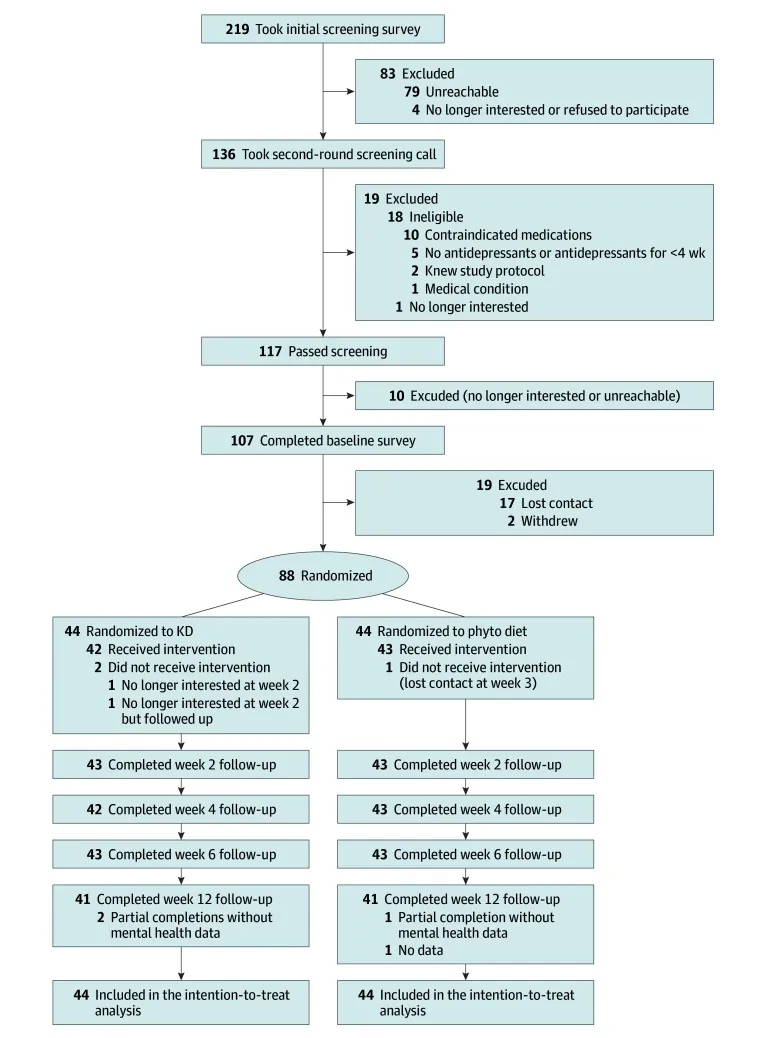
- 88 adults with treatment-resistant depression randomized for 6 weeks to a ketogenic diet or a healthy control diet
- PHQ-9 reduction of 10.5 vs 8.3 points, between-group difference of 2.18 points (P=.05), not significant at week 12
- No difference in secondary measures, no serious adverse events
Limitations This was a small, short trial with a small effect size and no differences at week 12 or in secondary measures, so there is not yet enough evidence to recommend it as a treatment.
Original Research
- Gao M, et al. · University of Oxford (Nuffield Department of Primary Care Health Sciences). A Ketogenic Diet for Treatment-Resistant Depression: A Randomized Clinical Trial. JAMA Psychiatry. DOI: 10.1001/jamapsychiatry.2025.4431
Copyright in the original research belongs to its publisher and authors.