Aging Clock Built From 204 Blood Proteins Predicts Risk of 18 Chronic Diseases and Death
An aging clock built from the plasma proteins of about 45,000 UK Biobank participants predicted the onset of chronic disease and the risk of death.

A study published in Nature Medicine reports that 204 proteins in the blood can estimate age accurately, and that this proteomic age also predicts chronic disease and risk of death. It was led by researchers at the University of Oxford in the United Kingdom.
Developed in 45,441 People, Validated in China and Finland
The researchers measured 2,897 plasma proteins in 45,441 UK Biobank participants and developed a proteomic aging clock. The 204 selected proteins correlated very highly with actual age (r=0.94). Prediction accuracy was similar in the Chinese (3,977 people) and Finnish (1,990 people) biobanks, at r=0.92 and r=0.94, respectively.
The older a person's proteomic age was compared with actual age, the higher the risk of 18 major chronic diseases, including heart, liver, kidney and lung disease, diabetes, neurodegenerative disease and cancer, as well as of multimorbidity and all-cause death. It was also linked to physical and cognitive function measures such as telomere length, frailty index and reaction time. The proteins that contributed most to the clock spanned a range of functions, including extracellular matrix, immunity and inflammation, hormones and neural structure.
Because this is a prediction tool built from large-scale observational data, it does not show that these proteins cause disease. Use in personal health management would require further validation of measurement cost and clinical usefulness.
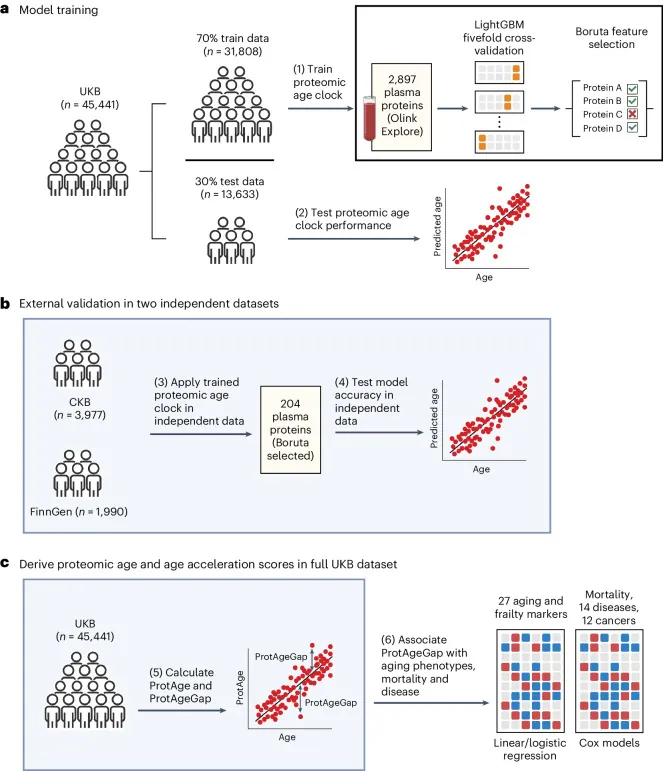
- 204-protein aging clock developed from 2,897 plasma proteins in 45,441 UK Biobank participants (r=0.94)
- Similar accuracy in independent cohorts of 3,977 people in China and 1,990 in Finland (r=0.92 and 0.94)
- Accelerated proteomic age linked to 18 chronic diseases, multimorbidity and all-cause death risk
Limitations This is a prediction model based on observational research and does not imply causation; its clinical value remains to be shown separately.
Original Research
- Argentieri MA, et al. · University of Oxford. Proteomic aging clock predicts mortality and risk of common age-related diseases in diverse populations. Nature Medicine. DOI: 10.1038/s41591-024-03164-7
Copyright in the original research belongs to its publisher and authors.