Natural Products & Plant Materials
Complete Biosynthesis of Horse Chestnut Seed Saponin 'Escin Ia' Mapped, With 10 Previously Unknown Enzymes Found
Researchers at the China Academy of Chinese Medical Sciences mapped the entire biosynthetic pathway of escin Ia, a raw material for drugs treating brain edema and venous insufficiency, and reproduced it in a tobacco relative.
Researchers at the Institute of Chinese Materia Medica, China Academy of Chinese Medical Sciences, mapped the entire biosynthetic pathway of escin Ia, a triterpenoid saponin found only in the seeds of plants of the genus Aesculus. In the paper, published in Nature Communications, they found 10 enzymes of previously unknown function in the Chinese horse chestnut (Aesculus chinensis) and connected every step.
Backbone hydroxylation, sugar attachment, acylation: three groups of steps complete the pathway
First, the cytochrome P450 enzymes AcCYP716BX1/2 and AcCYP714E67 add hydroxyl groups at specific positions on the β-amyrin backbone to make protoescigenin. Next, the glycosyltransferases AcUGT94AK1/3/6 and AcUGT87AZ3 attach sugars in sequence to form escuroside B. Finally, AcCCL3 supplies tigloyl-CoA and AcBAHD13/17 attach it, leading to desacetylescin Ia. The team expressed these genes together in the tobacco relative Nicotiana benthamiana and succeeded in producing escin Ia heterologously.
Escin is a drug raw material used for brain edema, venous insufficiency and other conditions, and until now it has depended on extraction from horse chestnut seeds. According to the researchers, having the whole pathway mapped lays a foundation for production using plant or microbial hosts.
However, this study focused on mapping the pathway and demonstrating heterologous expression. It did not address industrial yield or cost-effectiveness compared with extracted material. Discovering biosynthetic enzymes also does not mean evaluating drug efficacy.
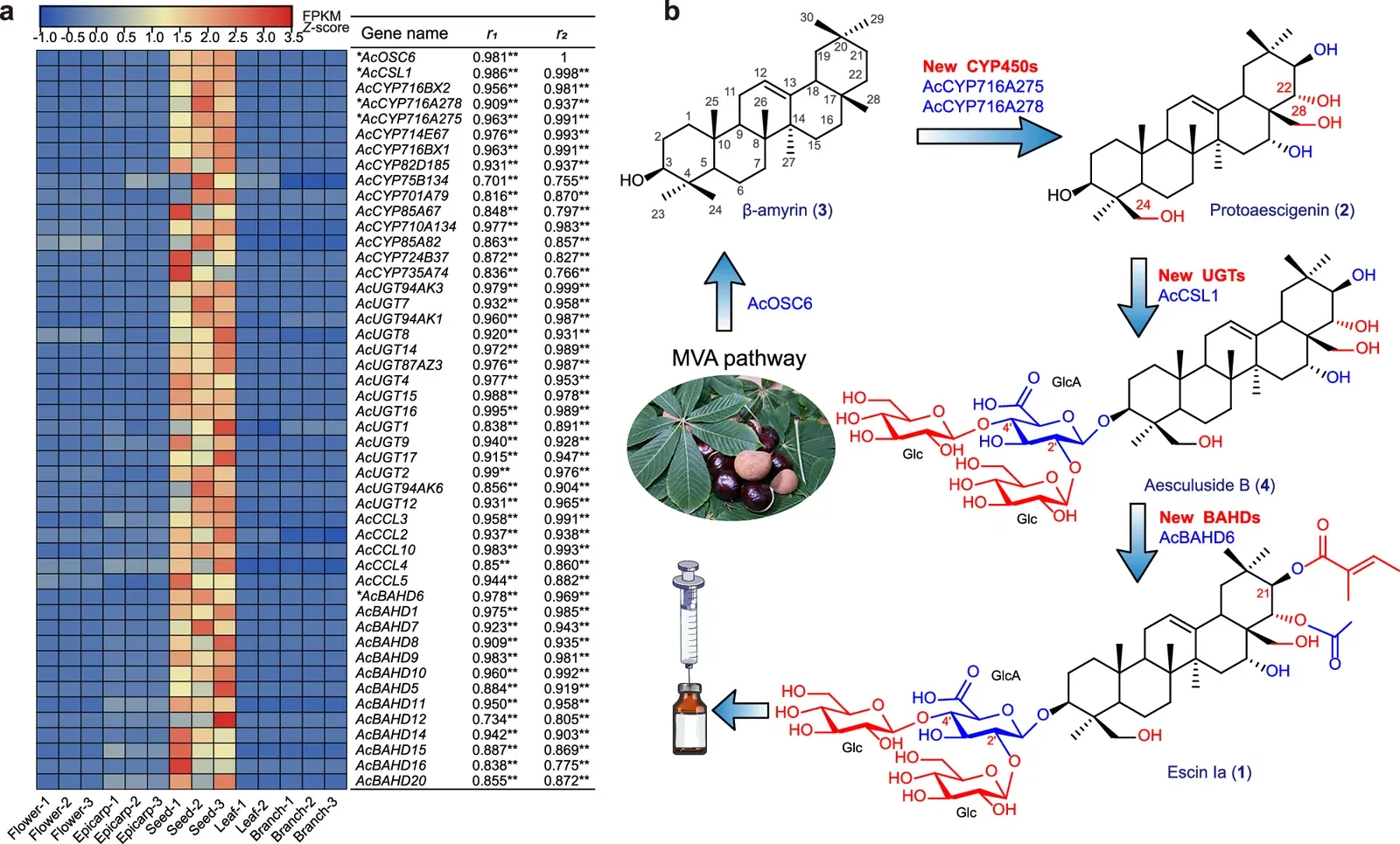
- 10 previously uncharacterized enzymes identified in Aesculus chinensis (3 P450s, 4 glycosyltransferases, 1 CoA ligase, 2 acyltransferases)
- Entire pathway reconstituted in Nicotiana benthamiana, with successful heterologous production of escin Ia
- Provides a basis for alternative production of a drug raw material that has depended on horse chestnut seed extraction
Limitations This study is at the stage of pathway mapping and heterologous expression, and does not address industrial yield, cost-effectiveness or clinical efficacy.
Original Research
- Wan H, Zhang M, Gao R, Xie X, et al. · Institute of Chinese Materia Medica, China Academy of Chinese Medical Sciences. Complete biosynthesis of the clinical agent escin Ia. Nature Communications. DOI: 10.1038/s41467-026-76851-3
Copyright in the original research belongs to its publisher and authors.