828 Million Adults Worldwide Have Diabetes: 59% of Those Aged 30 and Older Go Untreated
An analysis pooling measured data on 141 million people found the burden of diabetes concentrated in low- and middle-income countries.

An analysis estimating that about 828 million adults aged 18 and older worldwide have diabetes was published in The Lancet. The NCD Risk Factor Collaboration (NCD-RisC), a network of researchers around the world, estimated trends in prevalence and treatment rates in 200 countries and territories all at once.
1,108 population-representative surveys, 141 million people
The researchers pooled data from 1,108 population-representative surveys with 141 million participants in which fasting blood glucose and glycated hemoglobin (HbA1c) were actually measured. Diabetes was defined as any of the following: fasting blood glucose of 7.0 mmol/L or higher, HbA1c of 6.5% or higher, or taking diabetes medication. Trends by country were calculated using a Bayesian hierarchical meta-regression model.
Over the roughly 30-year analysis period, the number of adults with diabetes rose by about 630 million. Age-standardized prevalence rose in 131 countries for women and 155 countries for men, with the largest increases in low- and middle-income countries in Southeast Asia, South Asia, the Middle East and North Africa, and Latin America. Of people aged 30 and older with diabetes, 445 million (59%) were not receiving drug treatment, which is 3.5 times the number at the start of the analysis. Korea's treatment rate rose substantially, placing it in the group of countries with treatment rates of 55% or higher.
Prevalence is rising, but treatment is standing still
In some countries in sub-Saharan Africa and South Asia, the treatment rate was under 10%. The researchers proposed that expanding health insurance and primary care must be accompanied by early detection and treatment programs. However, countries with little survey data rely heavily on model estimates, and because treatment was defined only as taking medication, the analysis does not reflect whether blood glucose is actually well controlled.
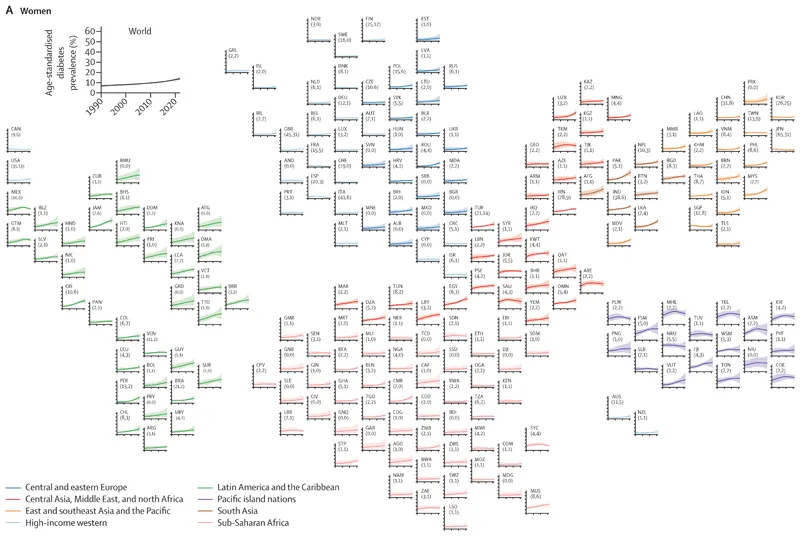
- Estimates for 200 countries and territories from measured data on 141 million people in 1,108 population-representative surveys
- About 828 million adults with diabetes, up by 630 million in about 30 years
- 59% (445 million) of patients aged 30 and older untreated; Korea is in the group with treatment rates of 55% or higher
Limitations Countries with scarce data depend heavily on the model, and the treatment rate reflects only whether medication is taken, so the level of glucose control is unknown.
Original Research
- NCD Risk Factor Collaboration (NCD-RisC) · NCD Risk Factor Collaboration (NCD-RisC). Worldwide trends in diabetes prevalence and treatment from 1990 to 2022: a pooled analysis of 1108 population-representative studies with 141 million participants. The Lancet. DOI: 10.1016/S0140-6736(24)02317-1
Copyright in the original research belongs to its publisher and authors.