Natural Products & Plant Materials
Herbal Granule 'Jinlida' Lowers Risk of Progression to Diabetes by 41%, Trial of 889 Finds
In adults with both impaired glucose tolerance and metabolic abnormalities, the risk of developing diabetes was lower in the Jinlida group than in the placebo group.
Results of a randomized trial testing whether Jinlida (JLD), a compound herbal granule approved in China for treating type 2 diabetes, can delay the onset of diabetes in prediabetes were published in JAMA Internal Medicine. This is the FOCUS trial, led by Guang'anmen Hospital of the China Academy of Chinese Medical Sciences, with 35 institutions in 21 Chinese cities taking part.
Median 2.2-Year Follow-Up, Hazard Ratio 0.59
The participants were 889 people aged 18 to 70 who had impaired glucose tolerance (IGT) together with several metabolic abnormalities. They took 9 g of Jinlida or placebo three times a day until diabetes was diagnosed or they left the study. Onset of diabetes was determined by two consecutive oral glucose tolerance test (OGTT) results. In 885 people analyzed and followed for a median of 2.2 years, the risk of developing diabetes was 41% lower in the Jinlida group than in the placebo group (hazard ratio 0.59).
On secondary outcomes as well, the Jinlida group had lower waist circumference, fasting and 2-hour post-meal blood glucose, HbA1c, triglycerides and the insulin resistance index (HOMA-IR) than the placebo group. However, the difference in HbA1c was small, at 0.20 percentage points.
The trial enrolled only Chinese people, and the abstract does not state the clinical trial phase. Because it is a compound formula mixing several herbs, it is not known which ingredient worked, and whether the effect lasts over the long term also needs to be confirmed.
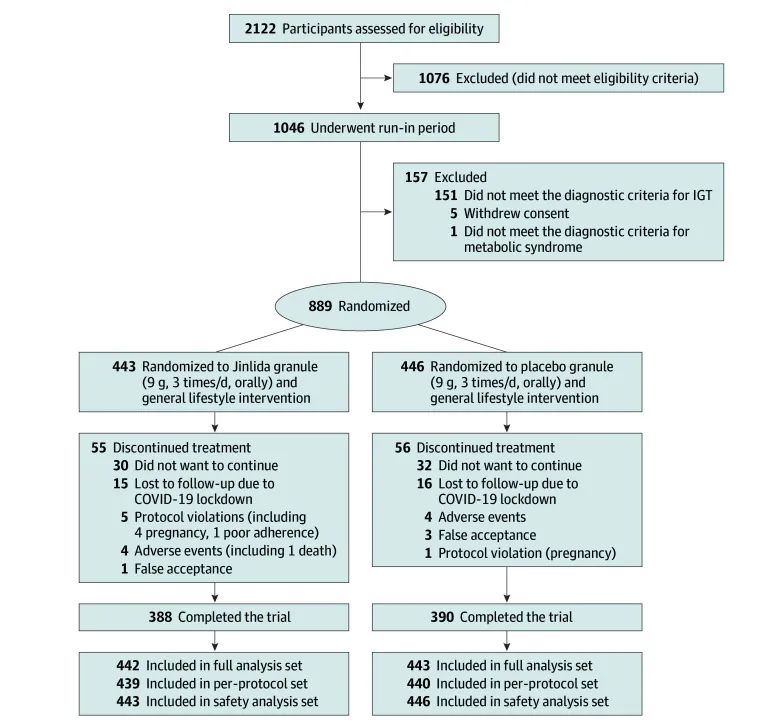
- Multicenter double-blind, placebo-controlled randomized trial at 35 institutions, 889 people assigned
- Hazard ratio for developing diabetes of 0.59 over a median 2.2-year follow-up
- Secondary outcomes such as waist circumference, blood glucose, triglycerides and HOMA-IR were also lower than with placebo
Limitations This is a single-country trial of Chinese people, and because it is a compound formula the active ingredients cannot be identified.
Original Research
- Ji H, et al. · Guang'anmen Hospital, China Academy of Chinese Medical Sciences. Jinlida for Diabetes Prevention in Impaired Glucose Tolerance and Multiple Metabolic Abnormalities: The FOCUS Randomized Clinical Trial. JAMA Internal Medicine. DOI: 10.1001/jamainternmed.2024.1190
Copyright in the original research belongs to its publisher and authors.