Epigenetic Aging Clocks Predict Disease Worse Than Basic Risk Factors Such as Smoking and BMI
In a follow-up of 1,108 middle-aged Finns for 7 to 9 years, a basic risk factor model predicted disease onset better than any aging clock model.

Epigenetic clocks, which estimate biological age from DNA methylation, predict chronic disease no better than traditional risk factors such as smoking, drinking and obesity, according to a study in Aging Cell. The analysis is by researchers at Tampere University and the University of Turku in Finland.
1,108 people in the Young Finns cohort, followed for 7 to 9 years
The researchers analyzed 1,108 participants in the Cardiovascular Risk in Young Finns Study who were 34 to 49 years old at the start and free of the diseases of interest. During follow-up, 222 (20.0%) were newly diagnosed with a noncommunicable chronic disease, including cardiometabolic disease, high blood pressure, cancer and fatty liver disease.
Comparing widely used clocks such as Horvath, Hannum, PhenoAge, GrimAge and DunedinPACE, they found that in models adjusted only for age and sex, PhenoAge (principal component version), GrimAge and DunedinPACE were significant predictors. However, a traditional risk factor model made up of age, sex, smoking, drinking, waist-to-hip ratio and body mass index predicted better than any model, including those with aging clocks. Still, the discrimination of all the models was not high.
These are results from an observational cohort limited to middle-aged adults in one country, so they are hard to generalize to older adults or other populations. The researchers pointed out that before aging clocks are used in the clinic or for personal health management, they must first show added value over cheap existing measures.
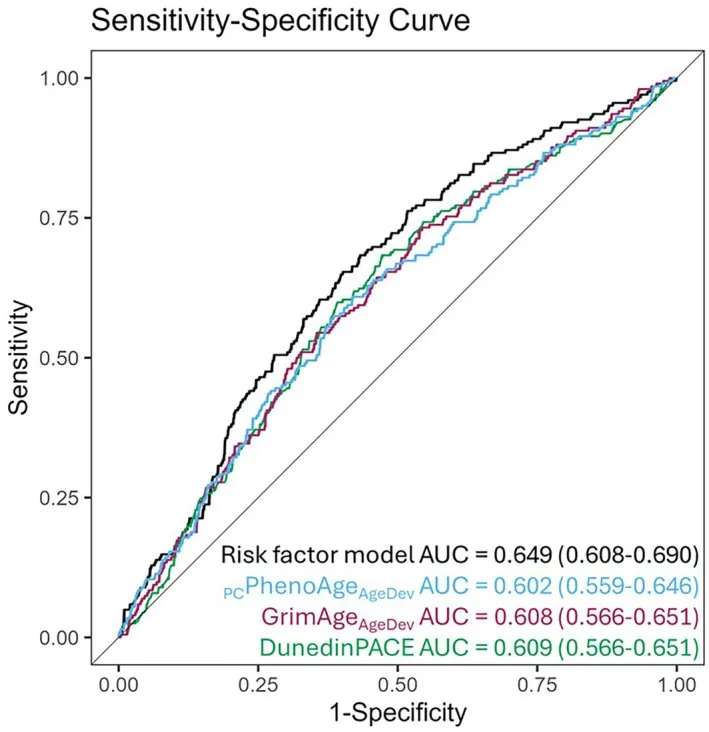
- 1,108 middle-aged participants in Finland's Young Finns Study followed for 7 to 9 years; 222 (20.0%) newly diagnosed with chronic disease
- PhenoAge, GrimAge and DunedinPACE were significant predictors on their own
- The model of age, sex, smoking, drinking, waist-to-hip ratio and BMI predicted better than every aging clock model
Limitations This is an observational study of a single cohort of middle-aged Finns, so it is hard to generalize to older adults or other populations.
Original Research
- Kostiniuk D, et al. · Tampere University / University of Turku. Traditional Disease Risk Factors Outperform Epigenetic Clocks as Predictors of Non-Communicable Disease Morbidity in a Middle-Aged Cohort. Aging Cell. DOI: 10.1111/acel.70626
Copyright in the original research belongs to its publisher and authors.