960 Mice Followed for Life on Calorie Restriction and Fasting: Genetics Mattered More for Lifespan
A 40% calorie restriction extended lifespan the most, but genetic background divided individual lifespans more than diet did.

Caloric restriction and intermittent fasting did extend the lifespan of mice, but genetics played a bigger part than diet in explaining differences in lifespan between individuals. The results come from researchers at The Jackson Laboratory and Calico Life Sciences in the United States, who followed 960 genetically diverse female mice for life.
Five diet groups, more than 200 traits measured repeatedly
The researchers divided Diversity Outbred mice into an ad libitum group, fasting groups (one day a week or two consecutive days), and calorie-restriction groups with intake cut by 20% or 40%. From 6 months of age until natural death, they repeatedly measured more than 200 traits, including body weight, a frailty index, grip strength and blood markers. Lifespan rose in proportion to the strength of restriction, and the median lifespan of the 40% restriction group was about 9 months (36.3%) longer than that of the ad libitum group.
However, lifespan varied widely even within the same diet group, and the influence of genetic background was larger than the effect of diet. The traits most strongly associated with lifespan were the ability to maintain body weight under handling stress and a high lymphocyte ratio. By contrast, metabolic improvements such as fat loss or lower fasting glucose were not associated with longer life.
The 40% restriction was accompanied by loss of lean mass and immune changes that could make animals more vulnerable to infection, and in mice that were heavy before the diet began, intermittent fasting had no effect on lifespan. The researchers stressed that better health and longer life are not the same thing. Because this was an experiment in female mice, it is hard to apply directly to people.
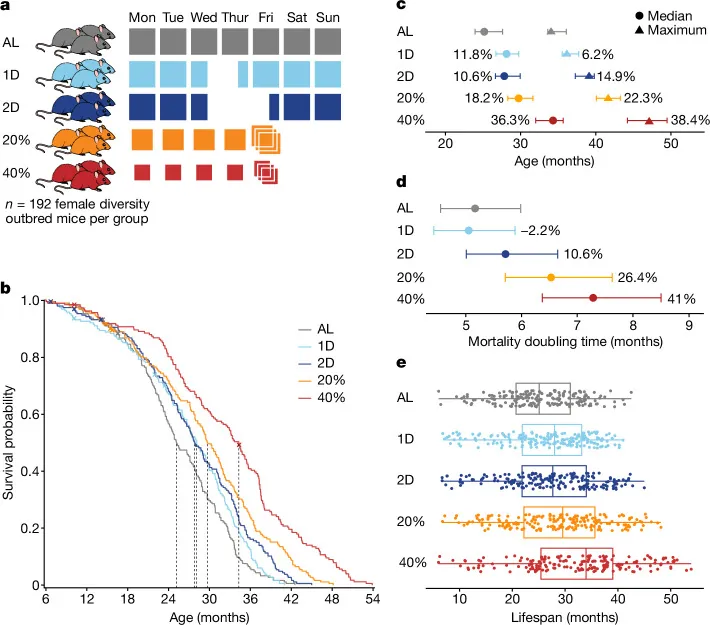
- 960 genetically diverse female mice were put on 20% or 40% calorie restriction or 1- or 2-day weekly fasting for life
- Median lifespan in the 40% restriction group was about 9 months (36.3%) longer than the ad libitum group, but genetics had a larger effect on lifespan differences
- Improvements in fat and blood glucose were unrelated to lifespan, and strong restriction came with loss of lean mass and immune changes
Limitations This is an animal study in female mice only and does not show the effects of calorie restriction or fasting in people.
Original Research
- Di Francesco A, et al. · The Jackson Laboratory / Calico Life Sciences. Dietary restriction impacts health and lifespan of genetically diverse mice. Nature. DOI: 10.1038/s41586-024-08026-3
Copyright in the original research belongs to its publisher and authors.